I did not know what I did not know. That is probably the most honest statement I can make regarding where I stood a few years into my data career. I could query databases, construct reports, and explain what the numbers indicated. I maintained data stores, wrote transformation logic, and kept the pipelines running. I assumed that was the full scope of the job. For a while, that was enough to be considered useful.
However, there was an invisible ceiling I kept hitting, and I could not decipher why. I was the first and only data practitioner in those early environments. I had no peers to benchmark against and no reference point for what exceptional looked like beyond closing tickets on time. And I was consistently closing them.
The core bottleneck was the nature of the work I was executing. I was generating reports and maintaining datasets that nobody had requested with strategic intent. Those projects were corporate afterthoughts: reporting on historical occurrences with zero alignment to where the company was steering. I knew how to execute technically, but I lacked the perspective to tie that work back to commercial outcomes.
It took me longer than I care to admit to understand the reality: the capabilities that launched my career were fundamentally different from the skills required to scale it.
Technical Competence Is Just the Starting Line
Technical foundations matter. SQL, Python, dimensional modeling, and BI architecture are non-negotiable requirements early on. You need them to secure your seat and prove operational credibility.
What nobody explains early in your career is that technical depth represents the floor, not the ceiling. Once you achieve baseline technical fluency, out-coding your peers ceases to be a competitive differentiator. What separates practitioners who stall from those who reach executive leadership is a completely different set of capabilities.
For me, the inflection point arrived when I pursued my MBA while working full time. The program required applying concepts immediately inside our organizations. That necessity forced me to shift my stakeholder conversations entirely away from data structures toward business strategy: Why do we service customers this way? What risks does leadership face right now? What decisions are stalled due to missing data?
That was the first time I recognized that my primary value was not the dashboard or the ELT pipeline; it was what those assets empowered leadership to execute. You do not need a degree to make this leap, but you do need the intentional choice to look up from the terminal and engage with the commercial game being played.
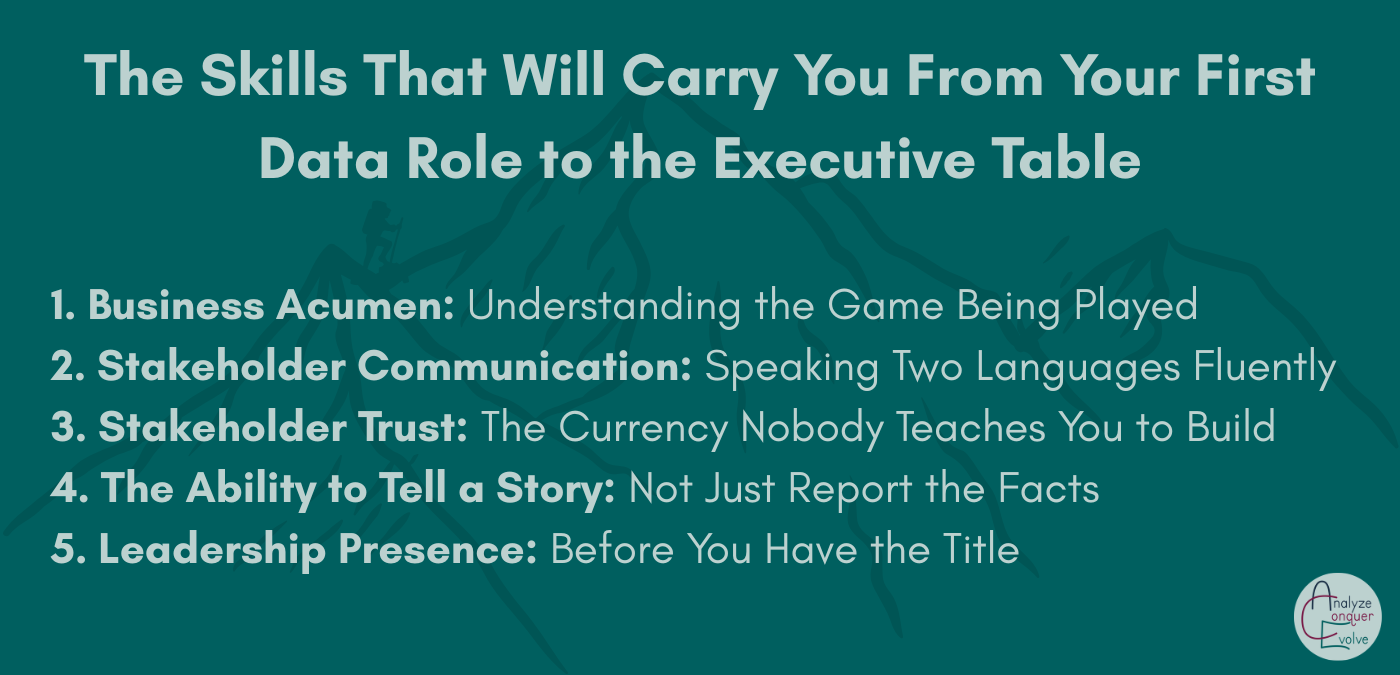
The 5 Core Capabilities That Propel Data Careers
1. Commercial Business Acumen
Business acumen does not mean reading academic finance textbooks; it means understanding why your company exists and how it generates cash flow. What metrics keep executive leadership awake at night? What high-stakes decisions are pending this quarter? What constitutes success for the VP of Sales versus the Head of Supply Chain?
The professionals who advance to leadership are not those who build the most mathematically complex models. They are the ones who step into a boardroom, grasp the macro operational challenge, and connect data directly to commercial outcomes.
To train this reflex: ask "so what?" every time you complete an analysis. Move beyond describing what the numbers show to articulating the specific operational decision that must occur because of the data.
2. Bilingual Stakeholder Communication
Early on, I believed getting the analysis right was 100% of the job. I would spend days validating edge cases, only to watch the findings get ignored in executive meetings. The analytics were accurate; the delivery missed entirely.
Executive data leaders speak two languages fluently: technical data mechanics and commercial business outcomes. They distill architectural complexity into executive clarity without stripping out necessary nuance. They know when to lead with a high-level strategic takeaway and when to dive into technical methodologies.
Communication also governs discovery: asking diagnostic questions before starting the work saves weeks of wasted engineering. Clarify the business urgency, the intended action, and past failed attempts before writing a single query.
3. Relational Stakeholder Trust
You can be technically brilliant and remain completely invisible. Developing deep stakeholder trust changes that dynamic permanently.
When business partners trust you, they consult you before major strategic choices are finalized, not after. They share the messy organizational context, internal politics, and real budget constraints because they know you will use that context to help them win. Trust ensures your analysis gets implemented rather than archived.
Building trust requires radical consistency: honoring commitments, flagging pipeline bugs before stakeholders uncover them, and stating transparently when you do not know an answer before going to find it.
4. Narrative Storytelling Over Data Reporting
There is a massive difference between presenting data and telling a story with it. Presenting data simply summarizes historical events. Narrative storytelling explains why those events impact operating margins, what happens if leadership does nothing, and what action should occur next.
High-impact leaders frame every major analytical presentation like a structured narrative: opening with business context, moving through diagnostic findings, and concluding with clear strategic recommendations that spark executive action.
5. Leadership Presence Ahead of the Title
A major mistake mid-career professionals make is waiting for a formal title before displaying leadership. Leadership presence is not granted by an HR promotion; it is demonstrated in how you show up during production outages, how you navigate ambiguous requirements, and how you mentor junior teammates.
Professionals who get tapped for executive roles are almost universally operating as informal leaders long before the promotion arrives: facilitating cross-functional alignment, asking uncomfortable questions, and taking ownership of business results rather than just completing tickets.
What Prevents High Performers From Making the Leap?
The primary barrier to executive progression is rarely technical capability: it is identity, combined with a lack of intentional long-term career planning.
High performers spend years building an identity around being the ultimate technical authority in the room. That identity was recognized, praised, and rewarded early on. Stepping away from the keyboard to focus on organizational influence feels uncomfortable, and many retreat back into collecting certifications and learning new syntax.
A new cloud certification or programming framework is valuable, but it does not answer the macro question: what does the next chapter of your career look like? Whether you aspire to become a Principal Enterprise Architect or a Vice President of Analytics, both paths demand identical leadership foundations: business acumen, stakeholder trust, and executive persuasion.
You must let go of the belief that your value is tied to your personal code output, and embrace the reality that your value lies in the enterprise decisions you influence.
Where to Direct Your Energy Today
To begin developing these leadership capabilities immediately:
- Shadow a Commercial Stakeholder: Schedule time with a department head to understand their operational pressures. Ask what metrics keep them up at night and what useful data looks like from their perspective.
- Volunteer for Ambiguous Initiatives: Step toward projects with vague requirements and unclear outcomes. Navigating operational ambiguity is where executive poise is built.
- Request Direct Feedback on Communication: Ask peers and leaders how your presentations land in the room, not just whether your SQL code was clean.
- Track Decisions Enabled, Not Just Dashboards Delivered: Review your recent deliverables and document the specific business choices they influenced.
- Plan Your Target Trajectory Deliberately: Determine whether you are building toward technical architecture or people leadership before you hit a career plateau.
Building Your Seat at the Table
Your technical foundation was hard-won, and it will always serve as your operational bedrock. However, it was never designed to be your ceiling.
The executive table requires far more than database querying: it demands the ability to shape how enterprise decisions get made. Cultivating that influence is a deliberate practice, and it is the single most valuable investment you can make in your career.