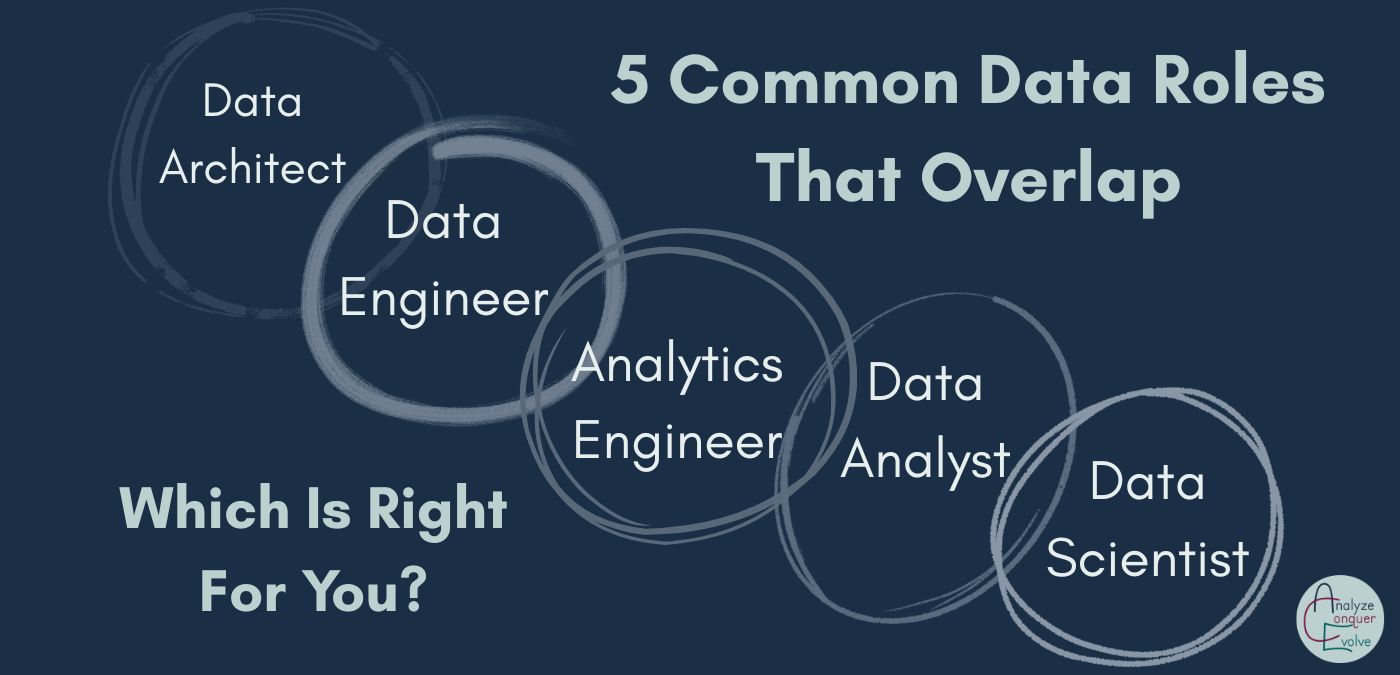
The data ecosystem is evolving rapidly, and so are the titles within it. One common theme I hear from the technical professionals I coach is the challenge of understanding which area is the true fit for their strengths. The reality is rarely straightforward: targeting a single generic title is not always the best career strategy.
Why Is Data Titling So Complex?
Organizations often struggle with what to label a role, or they have not yet adopted modern distinctions like Analytics Engineer. Many engineering teams restructure internally but never update the titles of team members whose core responsibilities have shifted.
Furthermore, posted job requisitions rarely fit into neat industry definitions. In smaller organizations, you often see massive overlap across the entire data lifecycle. As a rule of thumb: the larger the data team, the more specialized and distinct the responsibilities become.
The 5 Most Common Data Roles Defined
1. Data Architect
Core Responsibilities: Identifying, evaluating, and standardizing the technologies, storage patterns, and governance processes the team leverages. Data Architects establish framework standards and test emerging technologies to assess ecosystem fit.
- Where is the overlap? Depending on organizational scale, seasoned Data Engineers often fulfill architecture responsibilities. At other companies, the Technical Lead or Engineering Manager assumes this mandate.
- Is it right for you? Data Architecture typically requires hands-on tenure as a Data Engineer first. If you enjoy high-level system design while mentoring others, look for early management or lead roles in mid-size organizations where you can bridge both worlds.
2. Data Engineer
Core Responsibilities: Ingesting raw data and landing it cleanly into data lakes or enterprise warehouses. Depending on stack complexity, this involves managed ELT tools (like Fivetran) or writing custom ingestion pipelines via REST APIs. They monitor pipeline health (Data Observability) and ensure source-level data quality.
- Where is the overlap? Strong overlap exists with Data Architecture and Analytics Engineering, as Data Engineers build the underlying infrastructure that those downstream roles require.
- Is it right for you? Focus on mastering advanced SQL, Python, distributed computing, and API integration. These roles often involve less direct interaction with non-technical business stakeholders, focusing instead on system performance and data reliability.
3. Analytics Engineer
Core Responsibilities: Leveraging SQL, Python, and data build tools (like dbt) to clean, transform, and model raw warehouse data into modular datasets for Data Analysts and business users. They act as the operational bridge between raw data lakes and consumable reporting layers.
- Where is the overlap? Heavy overlap with Data Engineers on code quality and version control, but Analytics Engineers focus intensely on business domain logic. They also overlap with Data Analysts by occasionally building foundational dashboards.
- Is it right for you? Ideal for practitioners who enjoy understanding how data informs business decisions and love building clean, reusable data models.
4. Data Analyst
Core Responsibilities: Using SQL, Python, BI platforms (Tableau, Power BI), or advanced spreadsheets to analyze data, uncover operational trends, and build automated executive reporting. They are the primary translators between business stakeholders and technical data teams.
- Where is the overlap? The Data Analyst role has the highest variance of all. Analysts frequently handle data transformation (Analytics Engineering), stakeholder requirements gathering (Business Intelligence), or early predictive modeling (Data Science).
- Is it right for you? If you possess a blend of strong business acumen, communication skills, and technical problem-solving, this is your natural home.
5. Data Scientist
Core Responsibilities: Designing and training predictive models, machine learning algorithms, and statistical experiments in Python or R to solve complex business problems. They spend significant time tuning feature performance, running regressions, and conducting hypothesis testing.
- Where is the overlap? Data Scientists tend to be more mathematically specialized, though they frequently execute deep-dive analyst tasks to validate assumptions.
- Is it right for you? If you have a passion for statistics, advanced mathematical modeling, and machine learning research, this is an excellent track. Note that these roles frequently expect prior analytical experience or specialized academic backgrounds.
How AI Is Reshaping Data Roles
The implementation of AI and automated code generation is transforming data workflows. The primary shift underway is automation: AI is steadily eliminating routine data firefighting, boilerplate query writing, and basic syntax troubleshooting.
This automation allows data practitioners to transition from reactive support to proactive data strategy. However, AI models cannot execute effectively without healthy data pipelines and sound governance in place.
Not Sure Which Path Fits Your Profile?
Navigating the data career landscape can feel overwhelming when posted job requirements do not match everyday work realities. If you are caught between titles, evaluating whether to pursue technical IC mastery or management, or working to future-proof your skills in the age of AI, dedicated guidance can save you months of trial and error.