If you ask most people what skills a data professional needs to develop right now, the answer is almost always the same: learn AI.
AI literacy matters. I will not argue otherwise. If you work in data and you are ignoring how generative models are altering tooling, ingestion workflows, and stakeholder expectations, that is a blind spot worth addressing immediately.
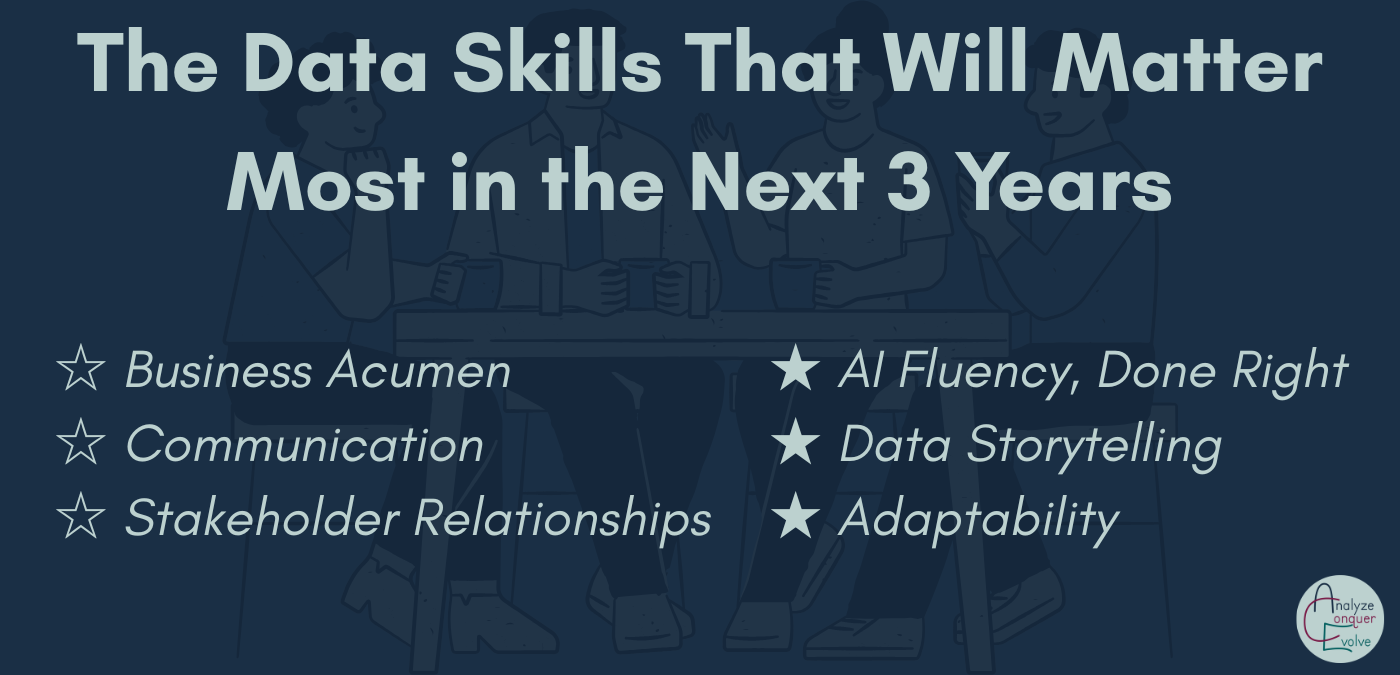
However, the obsession with AI has crowded out a far more important reality: the data professionals who will command the highest compensation and influence over the next three years are not merely prompt engineers. They will be the practitioners who blend AI fluency with enduring competencies that have driven technical value for decades.
The Technical Foundation Is Not Going Away
There is widespread confusion regarding what automated code generation actually replaces.
SQL remains non-negotiable. Not simple SELECT statements, but deep, confident SQL: complex analytical window functions, multi-table joins, subqueries, and database performance tuning. AI models can generate syntax quickly, but if you cannot read what they produce, verify its execution plan, and optimize it when it degrades warehouse performance, you are building on infrastructure you do not truly control.
Python continues to expand across every data specialty. Not because every analyst must architect distributed software, but because the ability to automate routine pipelines, connect to third-party APIs, and process data at scale outside the limitations of a BI interface is expected at mid-level roles and above.
Data quality and pipeline testing skills remain severely undervalued yet critically needed. Every company manages bad data, and very few resolve it at the point of ingestion. Practitioners who know how to architect schema tests, catch anomalies upstream, and quantify the commercial risk of corrupted records solve the most expensive operational headaches in tech.
Core Capabilities That Are Now Non-Negotiable
Throughout my career, when high-potential data professionals stalled in their progression, it was rarely due to a technical gap. It was almost always an absence of these three competencies:
1. Genuine Business Acumen
Knowing table schemas is insufficient. You must understand the underlying business model the data reflects:
- What does this KPI indicate to the business unit accountable for it?
- What operational decision hinges on this report?
- What action will the business take if this metric shifts by 10% next month?
These are commercial questions, not database questions. The analysts who answer them fluently earn executive trust and are invited to high-leverage strategic initiatives.
2. Clear, Multilingual Communication
I have seen technically gifted engineers get passed over for promotion because they could not articulate their findings to non-technical stakeholders. Translating complex distributions and statistical anomalies into plain-language business insights is a survival skill.
This does not mean oversimplifying the work; it means adapting to your audience. A technical peer needs architectural nuance; a CFO needs operational trade-offs and margin impact. Exceptional professionals shift between those registers effortlessly.
3. Strategic Stakeholder Partnerships
Analytics never happens in isolation. It operates inside an ecosystem of competing priorities and varied data maturity levels. The practitioners who excel build cross-functional relationships before they need them, checking in regularly and collaborating to define the right problem statement rather than passively waiting for a ticket.
Skills That Separate Good from Exceptional
Three differentiators will quietly define top-tier talent in the coming years:
AI Fluency, Handled with Discipline
The practitioners who gain the greatest leverage from AI do not treat it as a shortcut to bypass thinking. They use it to automate boilerplate routines, accelerating exploratory analysis so they can dedicate their bandwidth to high-judgment strategy.
There is also an operational risk: AI generates plausible-sounding output, but it regularly introduces hallucinations and subtle logic errors. A practitioner who lacks the depth to audit AI-generated code is not productive; they are an organizational risk. Knowing when to trust an automated script and when to audit it rigorously is an essential skill.
Data Storytelling That Drives Action
Raw numbers never speak for themselves. In an era where organizations collect petabytes of records, the ability to isolate the critical signal from the noise and construct a coherent narrative is a genuine competitive advantage.
Data storytelling is not about decorating a slide deck with charts. It is about understanding the primary friction point in the business, guiding stakeholders through the analytical evidence, and showing them exactly what decision needs to be made next.
Operational Adaptability
The data ecosystem has evolved more in the past five years than in the previous decade. Modern data stacks, cloud warehouses, and automated build tools arrive continuously. The practitioners who thrive do not anchor their identity to a single vendor tool; they build strong theoretical fundamentals so adopting the next paradigm feels natural.
What This Means for Your Career Stage
How you apply this blueprint depends on your current trajectory:
- Early Career: Prioritize technical depth first. Master SQL, establish a working foundation in Python, and learn data modeling principles. These assets provide the baseline context required to leverage AI tools responsibly.
- Mid-Career: Your limiting constraint is rarely technical syntax; it is business influence. Focus on executive communication, cross-functional stakeholder management, and translating data deliverables into measurable revenue or cost savings.
- Data Leaders: Audit whether you are training your team purely on software tools or cultivating their commercial fluency. A team that excels technically but cannot articulate its value to the business will perpetually battle for headcount and respect.
Looking Ahead
AI is an important component of the data landscape, but it is only one piece of the puzzle. The practitioners who command respect over the next three years will be the ones who pair disciplined technical mastery with commercial intuition, clear communication, and continuous adaptability.