There is a version of a data team that gets invited into the room early. Stakeholders actively seek their perspective before high-stakes decisions are finalized. Their recommendations carry real executive weight. When an ambitious initiative kicks off, leadership immediately says: "Let's get the data team involved from day one."
And then there is the other version. They are handed technical requirements after the commercial strategy is already locked in stone. They are asked to validate decisions that have already been made. They construct elaborate dashboards that nobody opens. They are technically brilliant, yet they are perpetually bypassed.
The difference between these two teams almost never comes down to coding syntax.
Having spent over 20 years in engineering and analytics leadership, I have seen brilliant technical teams get sidelined while average practitioners earned permanent seats in executive discussions. The gap is not your SQL proficiency, your Python depth, or your modern data stack. It comes down to three factors data professionals consistently underestimate: commercial business alignment, proactive stakeholder trust, and the soft skills required to bridge the two.
Why Technical Skill Alone Fails to Deliver Influence
Early in a technical career, your focus centers entirely on tooling: mastering SQL, structuring database schemas, tuning machine learning models, and building resilient ELT pipelines. That foundation is vital for execution.
However, technical capability alone will not protect you from being treated as a service desk. The most influential data professionals are not necessarily the ones writing the most elegant queries. They are the ones who connect analytical insights to commercial outcomes, communicate findings so leaders lean in with interest, and establish relationships with stakeholders long before a project ticket is ever opened.
Bypassed data teams are often technically flawless. What they lack is the ability to make the business feel the tangible value of what they build.
The Business Alignment Problem
The greatest challenge facing analytics teams today is not infrastructure scale: it is business alignment.
Most organizations claim to be data-driven, yet few understand what that looks like in daily practice. The symptoms are unmistakable: executives optimizing for vanity metrics that drive zero decisions, BI portals filled with neglected dashboards, and data teams excluded from strategic planning until the final sprint.
When an analytics team is detached from commercial objectives, they devolve into an order-taking service desk. They react to tickets, deliver reports without context, and spend their days explaining why the deliverable missed expectations because nobody asked the right questions upfront.
Closing this divide requires proactive leadership:
- Audit Organizational Objectives: Most companies update department and executive targets quarterly. Do you know them cold? Can you connect your current backlog directly to those milestones? If your team cannot articulate that connection, your stakeholders certainly will not.
- Speak the Language of Commercial Outcomes: Stop describing the technical mechanics of your pipelines. Frame your impact around business metrics: analyst hours reclaimed, revenue influenced, infrastructure costs curtailed, and strategic decisions accelerated.
- Advocate for Discovery-Phase Involvement: When you learn about an initiative after the scope is decided, push for early entry. Demonstrate to leadership that data analysis belongs in discovery, not merely in late-stage delivery.
Stakeholder Trust: The Currency You Cannot Skip
You can architect the cleanest, most performant warehouse infrastructure on the market. If stakeholders do not trust the data, do not trust your team, or feel ignored during requirements gathering, the work is effectively useless.
Trust is built incrementally through consistent habits:
1. Active Listening Before Solutioning
When a stakeholder submits a request, resist the urge to prescribe a technical architecture immediately. Begin by uncovering the underlying need: What commercial decision hinges on this metric? What is the current operational bottleneck? What does success look like for your department? High-performing practitioners ask twice as many questions as they offer answers during discovery.
2. Proactive, Cadenced Communication
Do not wait for stakeholders to follow up on stalled tickets. Maintain a lightweight, regular communication cadence: share progress updates, flag pipeline risks before they cause downstream panic, and anticipate shifting departmental priorities. Command of stakeholder relationships prevents frantic fire drills.
3. Delivering What They Need, Not Just What They Asked For
Stakeholders understand their business domain, but they do not always know what analytical models are possible or which variables matter most. High-trust teams ask probing questions, push back constructively when a requested report fails to solve the root problem, and deliver a more effective solution than the original ticket outlined.
The Soft Skills That Define High-Impact Teams
Labeling interpersonal capabilities as "soft skills" is misleading: in technical organizations, these capabilities are the actual drivers of leverage. This applies equally to Data Engineers, Analysts, and Directors.
- Connecting the "Why": As Simon Sinek emphasizes in Start With Why, professionals engage at a substantially higher level when they understand the purpose behind their effort. Connect daily data cleanup to the enterprise mission so your team operates as partners rather than ticket-closers.
- Championing Unpopular Foundational Work: Critical engineering tasks (such as governance, data debt remediation, and testing automation) rarely generate immediate executive praise. The leadership skill required here is translation: demonstrating how unaddressed technical debt increases error rates and degrades executive reporting.
- Translating Technical Complexity for Non-Technical Audiences: Analysts and engineers must explain their workflows in plain, unambiguous terms: why certain input schemas are required, what transformations will occur, and how the output informs decisions. When you eliminate technical jargon, cross-functional collaboration accelerates.
- Making Technical Impact Visible: High-quality work does not speak for itself in a busy enterprise. Regularly publish brief, outcome-oriented summaries of what your team shipped and what commercial value was unlocked.
What Teams With a Seat at the Table Do Differently
The data organizations that shape enterprise direction share distinct operating patterns:
- They do not wait for an invitation; they build relationships that make their presence indispensable.
- They do not merely answer stakeholder questions; they ask probing business questions first.
- They measure success by operational outcomes rather than technical ticket volume.
- They recognize that communication and commercial acumen are essential partners to technical excellence.
Three Concrete Places to Start Today
To begin shifting your data team from a reactive service desk to a respected strategic advisor:
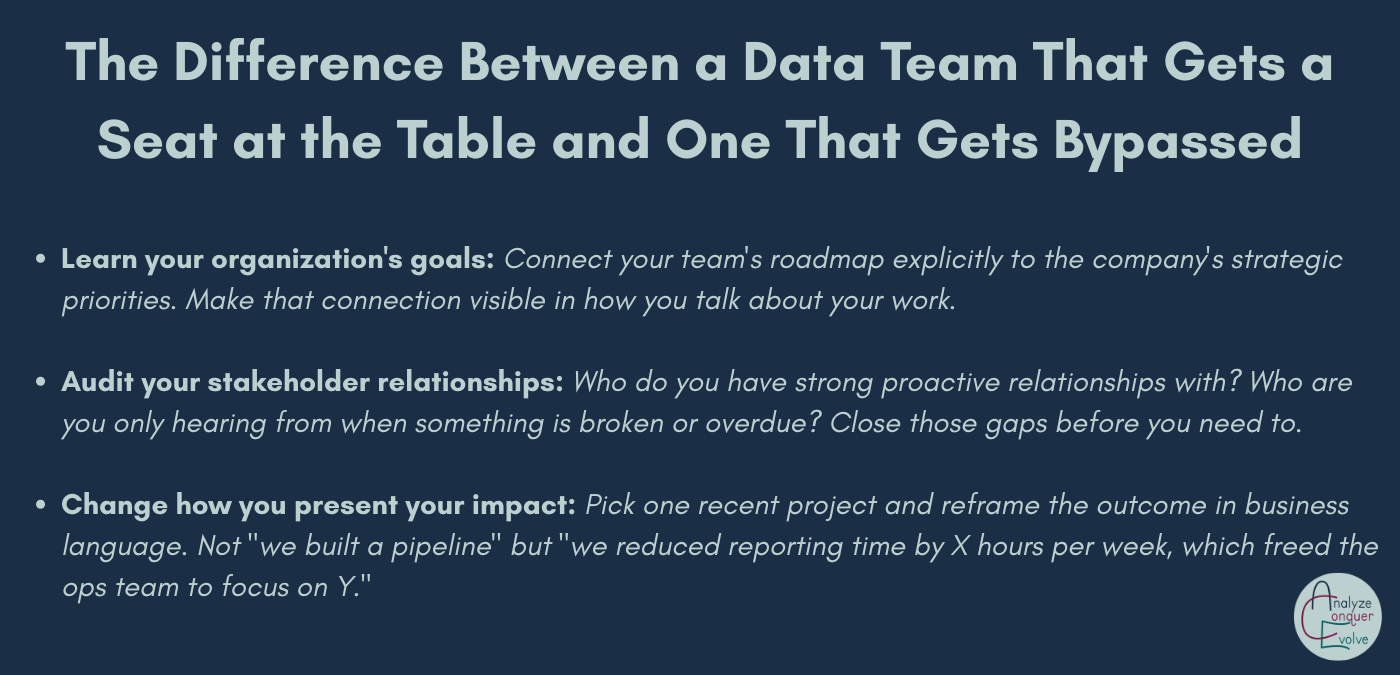
- Learn Your Company's Core Goals: Map your team's immediate sprint backlog directly to stated quarterly revenue, retention, or efficiency targets.
- Audit Stakeholder Relationships: Identify key partners you only hear from when systems break or reports are late. Reach out to schedule casual 15-minute alignment checks before emergency requests emerge.
- Reframe Your Deliverables in Business Language: Select one recent pipeline or dashboard release and rewrite its summary: replace technical stack descriptions with the specific decisions and hours saved for the business.
These consistent adjustments reshape how your team is perceived across the enterprise, securing your permanent seat at the decision-making table.