My first year as a manager was rough.
I had checked every traditional preparation box: mentored junior engineers for years, raised my hand for high-visibility stretch projects, volunteered to run departmental meetings, and presented to executive leadership. I prepared with intent.
And I still spent my first months feeling like I was failing.
Not because I lacked work ethic or intelligence, but because I brought an outdated mental model to the role. Nobody handed me an operational playbook. Nobody sat me down to explain: "Everything that made you exceptional as an individual contributor will actively work against you now. Here is how to succeed anyway."
This post is that exact playbook. If you are stepping into technical management for the first time, or feeling unsteady in a new leadership position, this is the blueprint I wish someone had handed me on day one.
Why the First 90 Days Actually Matter
The first three months establish how your direct reports view you, how cross-functional peers evaluate your credibility, and how executive leadership gauges your potential.
The operational patterns you set in this window quietly become your team culture. The relational trust you establish (or fail to cultivate) determines how your group handles severe pressure when production outages occur. Research consistently demonstrates that leaders who take time to listen, audit, and observe before acting dramatically outperform those who arrive with an immediate change mandate.
The First 30 Days: Listen More Than You Talk
What to Do
- Lead with Open-Ended Diagnostic Questions: Schedule dedicated 1:1 sessions with every team member during your first two weeks. Use consistent questions: What are you most proud of on this team? Where do you encounter the most friction? What does great managerial support look like to you? If you had a magic wand, what single operational process would you change? Then stop talking, take notes, and observe what remains unsaid.
- Map the Informal Org Chart: Every organization has two structures: the hierarchy on the HR chart, and the network that actually drives execution. Identify the informal leaders: who do engineers consult when architecture questions get tough? Who do business stakeholders call when they need an emergency answer?
- Align Success Criteria with Your Manager: In week one, ask your manager directly: What does an exceptional first 90 days look like to you? What core organizational problems do I need to understand deeply? Eliminating ambiguity early establishes mutual accountability.
- Anchor the Work to Strategic Business Goals: Learn the executive objectives driving your department. Understand where those targets live and how your team's everyday backlog maps to them.
What to Avoid
- Arriving with an Immediate Change Agenda: Every workflow exists for a reason; some reasons are solid, while others are historical relics. You cannot differentiate between the two in week three. Respect the current state before determining what to restructure.
- Trying to Maintain Peer Status: The moment you become a manager, the social dynamic fundamentally changes. Attempting to preserve informal peer dynamics at the expense of managerial boundaries creates confusion. You can remain warm, empathetic, and approachable without pretending you are still an IC peer.
- Confining 1:1s to Stiff Boardrooms: Step away from traditional conference rooms. Walk the building, grab a coffee, or use informal settings to encourage candid conversation.
Days 30 to 60: Diagnose the Real Systemic Problems
What to Do
- Audit Calendar and Focus Time: Track where your team's energy is actually spent. How much time is lost to reactive firefighting? Are engineers stuck in bloated, recurring status meetings? Auditing calendar load frequently uncovers that technical teams lose 20% to 30% of their build capacity to meetings that should be async updates.
- Catalog the Hidden Backlog: Pinpoint the critical work that never gets prioritized: accumulating technical debt, fragile manual data transfers, and undocumented processes residing in a single engineer's head. Document these gaps without attempting an immediate overhaul.
- Construct a Stakeholder Perception Map: Schedule 20-minute listening sessions with key business partners your team supports. Ask them directly what is working, where handoffs fail, and what they wish the engineering team did differently.
- Establish Predictable Operating Rhythms: Introduce clean, consistent cadences: structured 1:1s, actionable standups, and transparent sprint prioritization.
What to Avoid
- Confusing Activity with Progress: Filling your calendar with nonstop introductory calls feels productive, but clarity is the true measure of leadership. Take the time required to build an accurate diagnosis.
- Oscillating Between Detachment and Micromanagement: Do not stay completely removed out of fear of overstepping, and do not hover over code reviews due to anxiety over outcomes. Understand the architecture deeply enough to remove roadblocks without seizing the keyboard.
- Postponing Difficult Conversations: If a behavioral dynamic or broken workflow needs correction, address it early. Tolerating dysfunction in month two signals tacit endorsement. Uncomfortable conversations do not become easier at day 90; they merely become overdue.
Days 60 to 90: Shift into Driving Outcomes
What to Do
- Define and Enforce the Top 3 Priorities: Synthesize your learnings into the three most vital departmental objectives for the quarter. Communicate them repeatedly. Context switching destroys engineering velocity; enforcing a strict Rule of 3 protects team momentum.
- Translate Technical Value into Business Outcomes: Executive leadership rarely sees the rewritten ingestion pipelines or automated testing checks that prevent outages. Translate that invisible engineering effort into business metrics: reduced operational costs, saved analyst hours, and faster reporting cycles.
- Establish Bidirectional Feedback Loops: In 1:1s, ask: What is one thing I could do differently to make your job easier? Deliver constructive, direct observations with clarity and empathy.
- Secure an Early Operational Win: Identify a manageable, visible bottleneck that your team can resolve cleanly. Securing an early, tangible win builds internal credibility and reinforces team confidence.
What to Avoid
- Becoming the Decision Bottleneck: If direct reports escalate every minor technical choice to your desk, you have created a bottleneck. Respond with: "What approach would you recommend here?" Your role is building autonomous problem-solvers, not serving as the sole decision-maker.
- Sacrificing Personal Bandwidth: Transitioning into management is mentally and emotionally demanding. If you fail to schedule personal recovery and protect your boundaries, you cannot lead effectively. Sustainable leadership is an operational requirement.
- Expecting Final Outcomes Too Soon: Trust and cultural transformation compound over quarters, not weeks. Do not evaluate your success against long-term metrics that the initial timeline cannot yet support.
What Nobody Tells You (The Honest Reality)
A few foundational realities rarely get documented in standard leadership books:
- The internal promotion transition is genuinely uncomfortable: Moving from peer to manager shifts friendships. Former teammates may feel uncertain or pull back. This is normal and does not mean you handled the promotion poorly; establishing a new relational baseline takes patience.
- Your code is now secondary to your coaching: Your primary value is no longer your personal output; it is your capacity to empower others and align their output with enterprise goals. Internalizing this mindset shift is essential for executive growth.
- Imposter syndrome often indicates strong self-awareness: In early leadership, self-doubt is common. Questioning whether you handled a situation correctly is usually evidence that you care deeply about leading with intent.
- Delegation is not abdication: Handing off an initiative without strategic context, milestones, or accountability is abandonment, not leadership. Effective delegation ensures the practitioner understands the objective, the underlying rationale, and the definition of done, while you remain available as a coach.
- Your team's focus time is more valuable than your own: Protecting your team from fragmented calendars, unplanned side requests, and ambiguous priorities is one of the highest-leverage responsibilities of a manager.
The 90-Day Roadmap Summary
Keep your focus simple across the three phases:
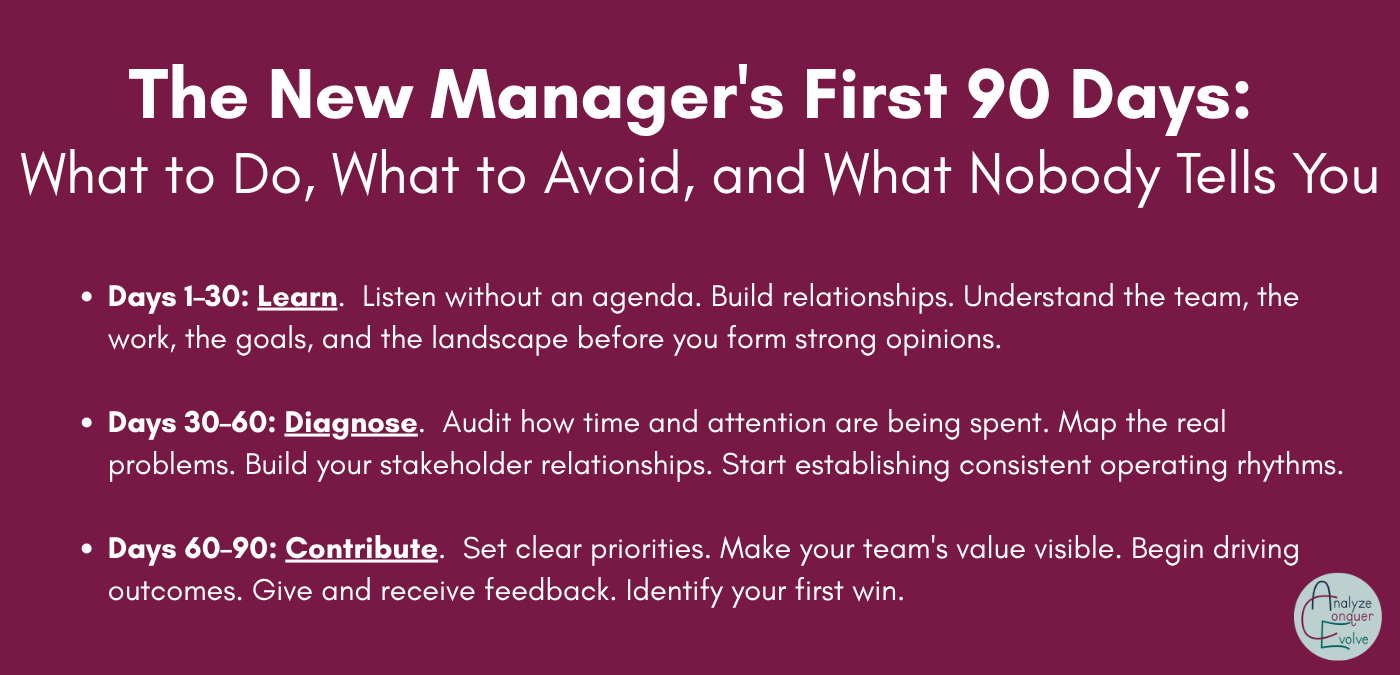
- Days 1 to 30 (Listen): Learn without an agenda, establish rapport, and understand the operational landscape.
- Days 30 to 60 (Diagnose): Audit time expenditure, catalog technical debt, and map stakeholder needs.
- Days 60 to 90 (Contribute): Enforce top priorities, make engineering value visible, secure an initial operational win, and foster two-way feedback.
The technical credibility and analytical discipline that made you a strong individual contributor remain valuable assets. In management, you simply direct those strengths toward developing people and optimizing systems.