Most professionals treat their LinkedIn profile like a static digital resume. They fill it out once, ignore it for years, and scramble to make hasty updates the moment they find themselves needing a new job.
Here is the fundamental limitation of that approach: your resume only works when you actively apply. Your LinkedIn profile works continuously, even when you are not applying to anything at all.
When your profile is architected correctly, recruiters find you in search results. Hiring managers review your background after seeing your resume. Industry peers follow your technical insights. Opportunities flow to you instead of you constantly chasing them.
That is what it means to build a profile that works while you sleep.
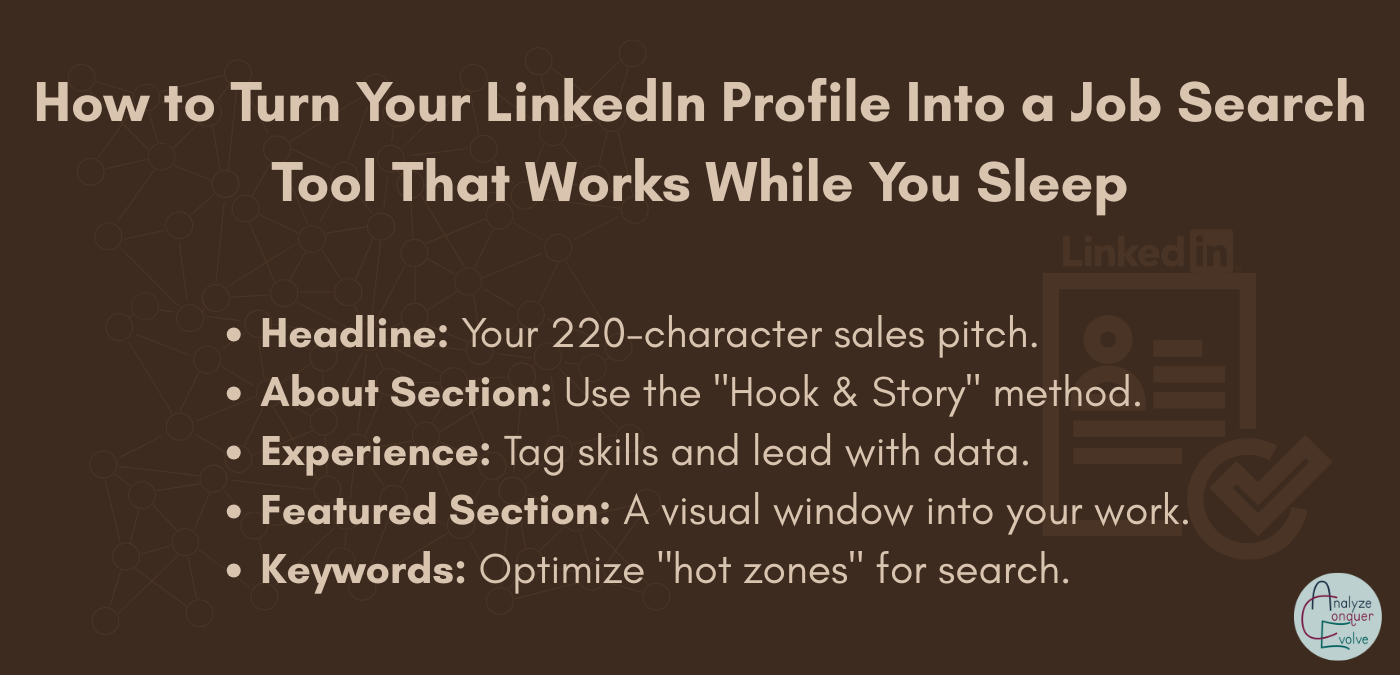
Most profiles remain under-optimized because professionals neglect the sections that carry the greatest algorithmic weight. Below is a tactical roadmap for overhauling your profile from top to bottom.
Section 1: Experience Bullets Need Outcomes, Not Job Descriptions
This is where most profiles fall flat. Professionals paste their corporate job descriptions instead of their measurable business results. They outline what they were assigned to do rather than what they actually delivered.
Recruiters and hiring managers already understand what a Data Analyst or Software Engineer is supposed to do. What they need to verify is your track record of impact.
✅ After (Outcome-Focused): Re-architected 14 core data pipelines in Snowflake and dbt, reducing query execution costs by 32% and cutting morning dashboard refresh delays from 4 hours to 15 minutes.
Every single bullet should answer one core question: so what? If a bullet point does not demonstrate a business outcome, operational efficiency gain, or problem solved, rewrite it.
Key guidelines for this section:
- Leverage the space advantage: Space is limited on a two-page resume, but LinkedIn allows you to provide deeper architectural context. If an achievement is on your resume, it belongs on your LinkedIn with expanded scope.
- Tag skills to individual positions: Associate your core technologies directly with the roles where you used them. This reinforces your keyword indexing within LinkedIn Recruiter.
- Prioritize top-heavy formatting: Place your highest-impact achievements at the top of each role entry where hiring panels will see them immediately.
- Update while details are fresh: Log achievements quarterly or as major milestones deploy rather than waiting for an emergency search.
Section 2: Your About Section Is Your Executive Pitch
The About section is the most underutilized area on the platform. Professionals either leave it blank or draft a third-person corporate biography that reads like a formal press release.
Your About section should read like a direct, professional conversation. Write in the first person. Speak directly to the hiring managers, recruiters, and collaborators you want to attract.
The 4 Elements of a High-Converting About Section
- The Hook (First 2 to 3 lines): These lines appear before the "...see more" cutoff. Open with your core specialization, domain depth, and the value you deliver to earn that click.
- Your Technical Narrative: Outline the complex problems you solve, the architectures you master, and what drives your engineering craft.
- Keyword Anchors: Weave in industry-standard technologies and methodologies naturally so search algorithms index your profile accurately.
- Clear Call to Action: Direct the reader on how to engage, whether inviting a direct message, sharing your portfolio link, or pointing to your scheduling link.
Because LinkedIn does not support rich document formatting like bold text or custom headers, use clean visual anchors (such as arrows, checkmarks, or bullet symbols) to break up paragraphs and make technical skill sets easily scannable.
Section 3: Your Headline Is Prime Real Estate
Your headline follows your name across the entire platform: in search query results, inside recruiter candidate pools, beneath comments, and in connection requests. It is the single most visible piece of text on your profile.
Settling for just your current internal job title (e.g., "Software Engineer at Acme Corp") squanders prime positioning. A standard title states what you are; a strong headline explains what you do, who you help, and your primary technical stack.
Target Role | Commercial Value or Specialty | Core Tooling Stack
Example:
Senior Data Engineer | Building Scalable Cloud Pipelines & Real-Time Analytics | Snowflake, dbt, Python, AWS
You have 220 characters available. Use them to incorporate high-intent search terms that recruiters use to filter candidate pools.
Section 4: The Featured Section Is Your Portfolio Window
The Featured section sits directly beneath your About section, occupying prominent visual screen space on both mobile and desktop views.
Curate this section intentionally:
- Pin a link to your GitHub repository, architecture portfolio, or personal website.
- Feature an article or technical post that generated strong discussion and demonstrates your domain authority.
- Highlight an executive case study or deck outlining a complex system migration.
Section 5: Searchability Powers Everything
LinkedIn operates as a database search engine. Recruiters utilize LinkedIn Recruiter using exact keyword strings, Boolean operators, and skill tags to locate candidates.
If your profile lacks modern keywords, you are invisible to those queries. Focus on these primary keyword zones:
- Headline: High-priority indexing weight for role titles and primary technologies.
- About Section: Excellent for semantic keyword variations, industry terminology, and methodologies.
- Skills Section: Populate your full allocation of 50 skills, prioritizing your top five for endorsements.
- Custom URL: Claim your personal URL slug (e.g., linkedin.com/in/YourName) to eliminate messy default numbers and improve external search indexing.
Section 6: Maintain Your Assets Continuously
Keeping your profile updated should be a routine habit, not an emergency reaction to a sudden layoff. When you deploy a major database overhaul, earn an advanced certification, or reduce infrastructure latency, document it immediately while the metrics are accurate.
When a hiring manager reviews your resume and transitions to your LinkedIn profile, they should find depth, consistency, and active professional momentum.
Make Your Profile an Inbound Engine
Do not wait until you need a new job to care about your public profile. By structuring your experience bullets around business outcomes, sharpening your headline, and loading your profile with relevant technical keywords, you build a digital asset that works continuously on your behalf.