Almost every organization I have worked with or spoken to in recent years describes itself as data-driven.
The phrase appears in strategy slide decks, surfaces during executive offsites, and gets written into corporate value statements and job postings. Yet in most cases, the moment you inspect everyday operations, you find an environment that looks far more like a data-informed aspiration than a truly data-driven enterprise.
That gap is not confined to one sector or company scale. I have seen it inside high-growth startups and global enterprise firms. It is rarely a technology deficit, and it is almost never a shortage of technical talent. It is fundamentally an organizational and cultural bottleneck rooted in a misunderstanding of what operational data maturity actually requires.
What Being Data-Driven Is Not
Before mapping out true data maturity, it helps to identify the superficial patterns frequently mistaken for it:
- Vanity metrics dressed up as executive insight: An executive dashboard displaying revenue, employee headcount, and ticket volume is simply reporting data. It is not delivering insight. When executive leadership reviews a chart and nods without evaluating what underlying mechanism drove the number or what action it demands, the company is merely compiling numbers, not interrogating them.
- A graveyard of abandoned dashboards: Low adoption rates are the clearest proof that an analytics team is detached from business reality. When reports are built and rarely opened, the problem is rarely visual design. It is that nobody clarified the business decision before opening the BI tool, nobody mapped the output to a workflow, and nobody verified adoption. Dashboards are infrastructure; culture is what happens around them.
- The data team operating as a ticket factory: When engineers and analysts spend their week processing an unending queue of one-off ad hoc requests, that is not an analytics strategy. That is a service desk. In a mature environment, the data team does not wait passively for requests: they sit alongside business partners, asking hard strategic questions and guiding outcomes.
What True Data Maturity Actually Looks Like
Data maturity is not determined by the size of your Snowflake warehouse or the complexity of your machine learning algorithms. It is measured by how consistently information guides operational choices.
1. Stakeholders Own and Govern Their Core Metrics
In a mature organization, business leaders do not treat data as an IT deliverable. They understand how their team creates and alters records, they take ownership of their primary KPIs, and they are held accountable for acting on performance signals.
Critically, this ownership includes data governance. Defining metric calculations, verifying source system inputs, and resolving data discrepancies are responsibilities business teams must share. When business leaders leave definition entirely to data engineers, conflicting numbers and fractured organizational trust inevitably follow.
2. The Data Team Shapes Strategy Early
When analytics leaders are integrated at the inception of a strategic initiative (rather than summoned at the end to construct a reporting layer), the outcome changes dramatically. Early integration ensures tracking frameworks are configured from day one, edge cases are caught before launch, and business teams have answers the moment initiatives go live.
3. Executives Actively Champion Data Literacy
Organizations that make sustained progress share a common asset: executive leaders who champion data literacy publicly, consistently, and with accountability. This does not mean training every marketer or operations lead to write complex SQL. It means instilling a baseline literacy across the enterprise so employees understand data hygiene, recognize flawed assumptions, and know what questions to ask.
The Three Gaps That Keep Organizations Trapped
Three operational divides consistently prevent companies from unlocking the full value of their data assets:
Gap 1: Business and Technical Alignment
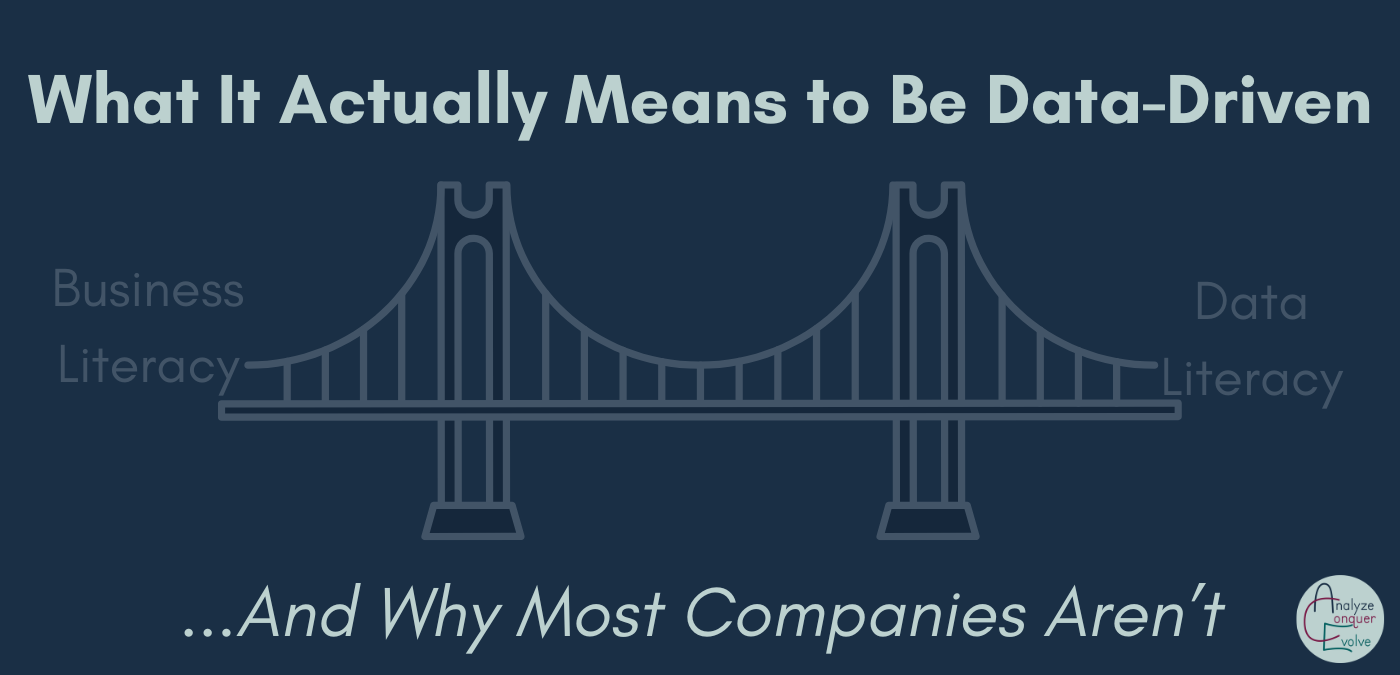
The primary bottleneck for modern data teams is rarely code architecture; it is business alignment. When data engineers lack strategic context, they optimize for infrastructure rather than commercial outcomes. When business stakeholders fail to understand analytical capabilities, they reduce advanced teams to spreadsheet formatters.
Closing this divide requires bidirectional effort. Analysts must learn the commercial language of revenue, margins, and customer retention. Business teams must develop sufficient analytical literacy to participate in architectural conversations.
Gap 2: The Foundation of Data Trust
You can deliver an airtight statistical model and still lose the room if stakeholders do not trust the underlying plumbing. Stakeholders do not make bold moves based purely on charts; they act on trust.
Before presenting recommendations, confirm that stakeholders trust the source system, understand the calculation methodology, and have seen known data limitations addressed transparently. Technical correctness is the baseline; establishing trust is what makes your analysis impossible to ignore.
Gap 3: Treating Governance as an External Problem
Data quality breakdowns are cultural warnings. They manifest as governance guidelines that are routinely bypassed without consequence, technical teams excluded from product decisions, and a widespread assumption that data integrity belongs solely to IT.
Governance is not a bureaucratic mechanism designed to slow development down; it provides the operational guardrails that allow teams to execute quickly with confidence.
Actionable Steps for Leaders to Close the Gap
To transition from aspirational statements to genuine data maturity, focus on three executive priorities:
- Tie Technical Work to Quarterly Objectives: Every engineer and analyst should clearly understand how their current sprint backlog maps to departmental and enterprise milestones. Make the invisible work (pipeline reliability, refactoring, and data modeling) visible to executive leadership so the value of technical hygiene is understood and funded.
- Shift from Ticket-Takers to Strategic Advisors: Before accepting an analytics project, audit the underlying business case: Why is this needed? What decision will be altered based on the numbers? Is this a recurring operational metric or a one-off curiosity? Establishing this filter protects capacity and elevates team influence.
- Invest in Reusable, Centralized Data Models: Inconsistent figures across departments erode trust faster than any production outage. Investing in centralized semantic models and standardized business logic ensures every team works from a single source of truth.
The Executive Opportunity
Becoming data-driven is not an IT project with an end date. It requires deliberate leadership, cross-functional accountability, and continuous investment in organizational literacy.
The companies that succeed are not those with the most elaborate tools; they are the organizations where leadership embeds data into everyday operations and empowers technical teams to act as genuine business partners.